
Spotted Lanternfly Honey
The only national commercial supplier of Penn State DNA-authenticated SLF honey — curated by Dr. Jack Anderson, PhD (Oxford), AHSTC Certified Honey Judge and combat veteran.
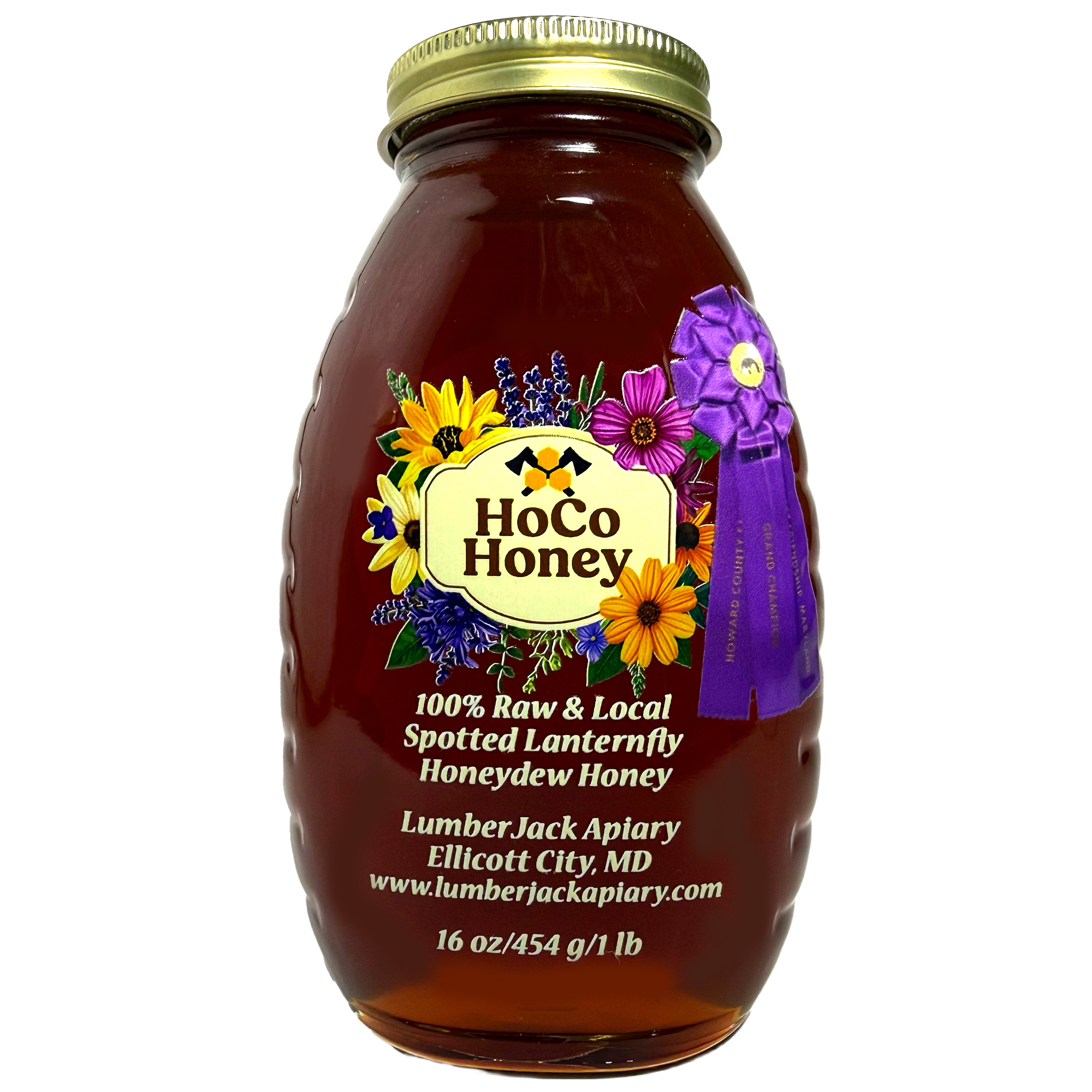
When Nature Adapts, Liquid Gold Follows
The Spotted Lanternfly has earned a reputation as one of the most destructive invasive species in the Mid-Atlantic region. But where most people see only a problem, LumberJack Apiary's bees — foraging across our Maryland out yards, including our headquarters apiary on a private historic manor in Ellicott City, Maryland — see opportunity.
Our bees collect the sugary honeydew secreted by lanternflies as they feed on local trees — processing it into a dark, mineral-rich honey that is unlike anything produced from traditional floral nectar.
1Choose Size
2Selected: 8 oz / ½ lb / 227g · $20.00
Available year-round. Ships to all 50 states.
We have never gone out of stock.
Manuka Built Its Empire on One Plant. Ours Has Eight.
Manuka honey's entire reputation rests on a single shrub in New Zealand — shipped 9,000 miles, sold at industrial scale, with a documented fraud problem the industry can't shake. Our Spotted Lanternfly honey is different in every way.
Eight Sources vs. One
Penn State University confirmed eight distinct plant families in our honey: caneberries, thistles, honeysuckle, alfalfa, plantain, buckthorn, asters, and clover — plus the honeydew of 170+ tree species the lanternfly feeds on. Manuka has one shrub. One country. One story.
Superior Flavor Complexity
Where Manuka can taste medicinal and one-dimensional, SLF honey delivers a bold, layered profile — dark caramel, molasses, subtle woodiness — shaped by eight plant families across a living Maryland landscape. Every jar is genuinely different.
No Fraud. No Supply Chain.
More 'Manuka honey' is sold worldwide each year than New Zealand can physically produce — a well-documented industry fraud problem. Our honey is grown, harvested, and packed in Ellicott City, Maryland. There is no supply chain to adulterate.
American-Made. Penn State Confirmed.
Unlike imported Manuka with inconsistent traceability, every batch of our SLF honey is analyzed by Penn State University — authenticating its identity as a genuine SLF honeydew honey and documenting its diverse floral origins. This isn't marketing. It's science.
Analyzed by Penn State University
Our honey was analyzed by Dr. Robyn Underwood, Penn State Extension Educator in Apiculture and researcher at the Center for Pollinator Research — one of the foremost honeybee research institutions in North America.
Her analysis confirmed two things: the presence of Spotted Lanternfly DNA in our honey — authenticating it as a genuine SLF honeydew honey — and a rich, diverse pollen profile drawing from eight distinct plant families across the Maryland landscape.
This is what real traceability looks like. Not a marketing certification — an independent scientific analysis of what's actually in the jar. Researchers are continuing to study what makes SLF honeydew honey unique. We're just grateful to bottle it first.
A Documented Result, Not a Slogan
Spotted Lanternfly honeydew honey is an emerging subject of serious scientific research. In laboratory antibacterial testing — the petri-dish diffusion method used to measure honey potency — SLF honeydew honey has shown antimicrobial activity comparable to or greater than Manuka in independent lab tests, including against E. coli and MRSA.
A 2025–2026 study by UTSA and Penn State Extension found SLF honey's total phenolic content and DPPH radical scavenging activity comparable to or greater than Manuka honey — one of the most studied medicinal honeys in the world. Earlier UK lab tests reported 3–4× the antimicrobial potency against E. coli and 2× against MRSA compared to Manuka benchmarks.
Research is ongoing. Penn State's Center for Pollinator Research continues to study what makes SLF honeydew honey distinct. Our honey is DNA-authenticated by Dr. Robyn Underwood, Penn State Extension Educator in Apiculture, confirming its genuine honeydew origin and documenting its diverse botanical sources across eight plant families.
Sources: Penn State Extension · WITF · ABC27 News · Beekeeping Today Podcast
6 Things to Know About Spotted Lanternfly Honey
From pest biology to your pantry — here's everything that makes this honey extraordinary.
A Pest Turned Productive
The Spotted Lanternfly (Lycorma delicatula) is an invasive planthopper from Asia that has spread across the Mid-Atlantic and Northeast. While it damages crops and trees by feeding on their sap, bees have found a way to turn this pest into something remarkable.
How the Honey Is Made
As Spotted Lanternflies feed on trees, they excrete a sugary liquid called honeydew. Local honeybees collect this honeydew and process it exactly as they would nectar — adding enzymes, reducing moisture, and capping it in the hive — producing a distinct honeydew honey.
Rich in Minerals & Antioxidants
Honeydew honeys are well-documented in European beekeeping traditions (think German Schwarzwälder Tannenhonig or Greek pine honey). Research shows they contain higher concentrations of minerals, oligosaccharides, and antioxidants compared to many floral honeys, giving them a deeper nutritional profile.
A Bold, Complex Flavor
Spotted Lanternfly honey is typically darker and richer than traditional floral honey, with notes of molasses, caramel, and a slightly woody or earthy finish. Its intense flavor makes it exceptional in cooking, cheese pairings, and dark roast coffees.
A Silver Lining for Beekeepers
In areas where Spotted Lanternflies are abundant, late-season honeydew flows can provide bees with a significant supplemental food source when traditional blooms are scarce. Beekeepers who understand this can leverage the lanternfly season rather than fight against it.
The Only National Supply
Spotted Lanternfly populations are concentrated in the Mid-Atlantic — and LumberJack Apiary is the only commercial operation bringing this honey to the national market. No two jars are alike, shaped by the trees, geography, and season. Available year-round. Ships to all 50 states.
Flavor Profile
Assessed to AHSTC judging standards and informed by authenticated DNA analysis performed by Penn State University. SLF honey is a genuine honeydew-nectar hybrid — richer and more mineral than a traditional floral honey, but with more brightness and lift than a pure honeydew variety like buckwheat.
Color
Dark amber to deep brown
Noticeably darker than floral honeys — a rich mahogany at full extraction. The honeydew component drives the color depth, consistent with other European honeydew varieties.
Aroma
Dark & warm with floral lift
The honeydew base reads as earthy and mineral — reminiscent of dark caramel or molasses — but the 11% honeysuckle and 22% Rubus pollen signatures push bright, sweet, and almost perfumed floral notes through the darkness. Distinctly complex.
Body
Full-bodied, viscous
Dense and satisfying on the palate — noticeably heavier than clover or wildflower. Slow to pour, slow to crystallize. When it does set, it tends toward a coarser, grainier crystal than clover.
Taste
Rich, fruity, and mineral-forward
The entry is immediately bold — warm dark caramel and molasses from the honeydew foundation. Then Rubus (caneberries, 22%) delivers a striking mid-palate brightness: a tart-sweet blackberry note that cuts through the richness and lifts the whole profile. Honeysuckle adds a trailing floral sweetness.
Finish
Long, herbaceous, gently earthy
Asters (11%), thistles (11%), and plantain (11%) make their presence known in the finish — a warm, slightly herbal, mildly bitter close that lingers pleasantly. This earthy length is the hallmark of quality honeydew honey.
SLF DNA
Medium concentration — authenticated
Lab analysis confirms a medium quantity of SLF DNA — sufficient to authenticate this as a genuine SLF honeydew honey. The remaining profile is a diverse polyfloral nectar blend from 8 local plant sources, creating the honeydew-nectar hybrid character.
Authenticated Pollen Sources
DNA analysis identifies the plant sources whose nectar and pollen bees gathered alongside the SLF honeydew. Each source contributes distinct flavor characteristics to the finished honey.
Rubus · Caneberries
Blackberry & raspberry — tart-sweet berry brightness, mid-palate lift
Cirsium · Thistles
Mineral, slightly bitter green — adds earthy complexity to the finish
Lonicera · Honeysuckle
Intensely sweet, perfumed floral — lightens and lifts the dark honeydew base
Medicago · Alfalfa
Mild, clean — similar to clover, supports the base sweetness
Plantago · Plantain
Earthy, herbal — contributes to the long, slightly vegetal finish
Rhamnus · Buckthorn
Woody, slightly bitter — adds tannin-like structure and depth
Symphyotrichum · Asters
Late-season wildflower — warm, herbaceous, rounds the finish
Trifolium · Clover
Clean, familiar sweetness — grounds the entire profile
The Taster's Summary
What emerges from this profile is a honey with multiple personalities in the best possible way. The SLF honeydew gives it a dark, mineral richness normally found only in buckwheat or pine honey. But the 22% Rubus signature introduces an unexpected brightness — a tart-sweet berry note that few people anticipate and almost nobody forgets. The honeysuckle (11%) adds a sweet perfume that threads through the darkness like a high note. Asters, thistles, and plantain anchor the finish in Maryland's late-season landscape.
The result tastes like Maryland in September: dark, layered, and alive — with something unexpected at every turn.
Pairing Notes
The bold mineral-and-berry profile makes this honey an exceptional food pairing companion. Aged sheep's milk cheeses (Manchego, Pecorino) and sharp blues benefit most from its complexity. On a charcuterie board, it bridges cured meats and aged cheeses better than any floral honey. In the glass, it elevates a Bourbon old fashioned or a dark beer cocktail. Try it on dark chocolate — the Rubus note creates a strawberry-chocolate-honey combination that shouldn't work but absolutely does.
How to Use Spotted Lanternfly Honey
Its depth and complexity means a little goes a long way. Think of it less like table honey and more like a premium finishing ingredient — the kind that makes everything it touches just a little more special.
Charcuterie & Cheese Boards
The bold, mineral-forward flavor of Spotted Lanternfly honey pairs beautifully with aged cheeses like Manchego, Gruyère, and sharp cheddar.
Dark Roast Coffee & Tea
Stir a spoonful into your morning coffee or black tea for a deep, caramel-like sweetness that complements robust roasts.
Marinades & Glazes
Use it as a base for pork, duck, or salmon glazes. The earthy complexity adds a layer of flavor that lighter honeys simply can't deliver.
Sourdough & Artisan Breads
Drizzle over warm sourdough with butter — the dark, rich flavor elevates a simple slice into something memorable.

A Note from the Apiary
"We were skeptical at first — the Spotted Lanternfly is a genuine problem for Maryland's trees and vineyards. But watching our bees adapt and work the honeydew flows was a reminder that nature always finds a way. This honey is as local and honest as it gets, and we're proud to offer it."
— LumberJack Apiary, Ellicott City, MD
Common Questions
Is Spotted Lanternfly honey safe to eat?
Yes. Bees process the honeydew through the same biological mechanisms they use for floral nectar — adding enzymes, evaporating moisture, and sealing it with beeswax. The resulting honey meets all standard food safety expectations.
Does it taste like regular honey?
Not exactly. It's darker in color and has a bolder, more complex flavor — often described as having hints of caramel, molasses, or light woodiness. Many people who enjoy darker honeys like buckwheat find it especially appealing.
Is Spotted Lanternfly honey safe for children?
Raw honey of any kind should never be given to infants under 12 months due to the risk of botulism spores. This applies to all honey regardless of source — including honeydew honeys. For children over one year and adults, this honey is considered safe to consume.
Is this honey available year-round?
Yes — while Spotted Lanternfly honeydew flows are seasonal, typically peaking in late summer through early fall, LumberJack Apiary maintains year-round inventory and ships to all 50 states. We have never gone out of stock. Order any time of year.
By buying this honey, am I supporting the lanternfly population?
No — bees passively collect the honeydew that lanternflies excrete; they do not assist the insects in reproducing or spreading. The lanternfly populations are driven entirely by environmental factors. If anything, the honey is a reminder that local beekeepers are present in and monitoring the ecosystem.
Order Online — Ships to All 50 States
The only national commercial supplier of Penn State-verified Spotted Lanternfly honey. Available year-round. Never out of stock. Also available at select Maryland farmers markets.
1Choose Size
2Selected: 8 oz / ½ lb / 227g · $20.00